
Ah, the ubiquitous Google. It’s not just for maps, web, images, videos, news, shopping, mail, analytics, advertising, translations and, well, everything under the sun anymore. Now it’s in your wallet. On second thought, make that, now it IS your wallet.
Yes, Google Wallet is here. As more and more businesses hop on board, expect to be able to use it at a retailer near you.
Google Wallet is a smart phone app on which you can store virtual versions of your credit and debit cards, so you can use your phone to make purchases and redeem offers.
It works by use of Near Field Communication (NFC). I’ll skip the technical jargon and simply say that NFC lets you wave your phone at a little device at the checkout counter to pay for your stuff. (Before you get too excited about having your phone cover your expenses, I should clarify that it does so with your money.)
In hopes of preventing innovative criminals from accessing your smart phone and walking away with your personal information, Google has loaded NFC with security features. It works only when your phone is very close to the receiving device. It turns off when the phone’s screen is dark. It requires PIN access. And the chip self-destructs if someone tries to hack it—yes,really.
As with most new technology, the demand will increase and Google Wallet (and future competitors) will become as common as, well, Google. I can just imagine where this might go…
• You have insufficient funds in your checking account. When you make a purchase, the phone automatically transfers funds from your savings and completes the transaction as you wave it over the transceiver.
• It’s payday. Just as workers used to line up at the time clock to punch in and out, now you line up at the transceiver and your paycheck is loaded onto your phone.
• In restaurants, servers bring a mobile transceiver to your table and you wave your phone to pay.
It may not be a real magic wand, but it sure comes close.
Mobile Banking by .
Jul 11
12
Increase in Mobile Usage Impacts Banking Industry
A growing number of Americans rely on their mobile phones to access the Internet, utilize money-saving applications and engage social networking websites. But a new survey shows consumers are also using their smartphones to manage their finances.
The results of the study – conducted by strategy consulting and research firm Mercatus – suggest that as mobile ownership increases, consumers are being more selective about the financial institutions they choose, opting for those that offer mobile banking features. The study shows that smartphones make up roughly 50 percent of all phones owned, an increase from one-third of cellphones owned last year. In addition, the study shows phone usage is actually down, while texting, Internet access and other functions have increased.
“With mobile emerging as a critical bank selection criteria, mobile capabilities become extremely important to a bank’s new customer acquisition and growth strategies,” said Mercatus partner Teresa Epperson. “This year, 35 percent of consumers told us that mobile was an ‘extremely important or important’ consideration in their selection of a new primary bank, up from 20 percent one year ago.”
A larger number of banks now offer mobile banking to customers who are enrolled in online banking accounts. Individuals can use mobile banking to inquire into their balance, transfer money and in some cases, deposit checks.
How financial institutions leverage social media with their customers is clearly a work in progress; and where this will trend in the future is very much to be determined. Will it be used primarily as a community tool or focus more on lead generation? Will it be a place to push products or primarily for engaging fans via contests and promotions? As FI’s continue to test the waters, ASB Bank in New Zealand has implemented a function that I think is one trend we will see rise in popularity over the coming months/years.
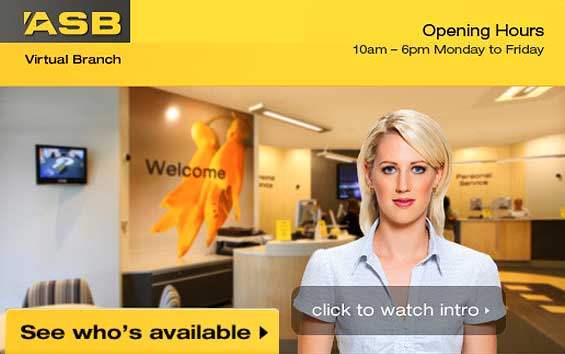
ASB’s Facebook page functions as a “Virtual Branch” where anyone (customers or prospects) can chat live with bank representatives about everything from home loans to savings accounts. The design evokes that of walking into a bank branch and the avatar of the female representative (albeit slightly eerie) emphasizes that you will be talking to a human. They are even covering their bases from a security perspective by prominently stating that chats will not appear on your (or their) Wall.
While I don’t have any stats on the success ASB has seen with this, judging from their over 17,000 fans (0.3% of New Zealand’s entire population), their social media efforts are working well. Even more importantly, efforts like these can ultimately save FI’s money by reducing call center volume and resolving issues quickly and easily for customers.
So what do you think about ASB’s Virtual Branch application? Would you live-chat with your bank through Facebook?
Banking by .
Jun 11
14
Secrets of Linking Up: Instant Credibility, Instant Rank Improvement
All the techniques for search engine optimization (SEO) we’ve looked at so far are designed to improve your SEO ranking in two ways: making your site relevant, and making it authoritative.
For your site to be highly ranked, it’s not just what you know (your site content), but who you know (what other resources are linked to you). Creating “rank-increasing” mutual links involves both approaches, and there are several ways you can do it:
Manual Link-Building. This is the easiest way to create mutual links and consequently; it’s also the least effective. It consists of placing your information on other reputable sites by writing comments, linking to social networking profiles, and submitting your site to online directories. Remember to include a link to your site every time you do this.
Editorial Link-Building – At the other end of the spectrum are editorial links, which are based primarily on the quality of your content. Sites with exceptional content or unique resources are more likely to generate mutual links without you having to extend an invitation. These have the most credibility, provided the source site is reliable and authoritative itself.
Mutual Link-Building – The most effective way to increase your relevance and authority is the “combo” approach, where you actively build relationships with sites, their owners, and others you’d like to have link to you. This requires having exceptional site content, reaching out to others who might be interested, and inviting them to link to your site while you link to theirs. Hence the term “mutual.”
5 Ways to Establish Mutual Links and Boost Your Search Rating
1. Be sure your site has great content. Update it regularly to keep it fresh and interesting.
2. Make it easy for readers to comment on your site.
3. Identify other sites that will increase your relevance and authority, then develop relationships with them.
4. Avoid sites with an overabundance of advertising. Just as you want to provide relevant, authoritative content, the sites to which you link should do the same.
5. Offer other sites the freedom to share your content provided they link back to you.
Marketing by .
Jun 11
10
Voice of the Customer: Radio Interview with Matt Wilcox
I first met Chad McDaniel, President of Execs in the Know, at the recent Customer Response Summit. I was honored to be invited as a guest on his radio show, Voice of the Customer, to discuss social media as an emerging customer response channel. Thanks to all of the listeners for their great questions, and many thanks to Chad for giving me the opportunity to share some of my thoughts and insights.
*The broadcast begins at :37
Marketing by .