
Jun 13
3
Mobile Banking: The Right Channel for Right Channeling

My presentation tomorrow on Right Channeling
I’m in Miami — yeah, life is tough — for the 7th Annual Mobile Banking and Commerce Summit. Tomorrow afternoon I’ll speak on mobile banking as it applies to Right Channeling. Presenting with me will be Michael J. McEvoy, managing director at ATH Power Consulting.
“Right Channeling” is the art and science of handling customer inquiries so that each customer lands in a channel best suited to her or him. I picked up the term from Ron Shevlin, senior analyst at Aite Group, whose championing of it has made Right Channeling more or less a household word among informed bankers.
Mobile banking is the fast-growing channel in bank history. Indeed, the medium has taken on a life of its own. Thirty percent of bank clients use mobile banking two or three times per week, 14 percent use it daily, and 4 percent use it several times each day. Small business owners “check in” on their accounts more often than retail clients do. Not surprisingly, data suggest that those who access their banking data online most often tend to be highest-value clients.
Besides the fastest-growing, mobile also happens to be the lowest cost channel in bank history. Want more good news? Retail and small business clients alike indicate a willingness to pay for mobile banking services. Here is a clear opportunity to provide better service based on what clients truly want, and — for once — not have to give it away.
Right now mobile makes up 7.5 percent of the current bank channel mix. By year-end we expect that to rise to 12.5 percent, and continue to climb from there.
No wonder! Clients can do more with mobile than with any other channel — pay bills, deposit, analyze and manage, open accounts, send or transfer funds, pay at point of sale, and more. Annual revenues to a bank per user from all of these activities are currently estimated at $98. That means we can afford to continue to develop this medium and its power to serve our clients. In fact, we can’t afford not to.
Banks have a great opportunity to be proactive here. I’ll close my presentation tomorrow with these three suggestions for banks:
• Leverage our position of trust with clients to make mobile money a seamless part of daily life;
• Extend loyalty strategies to enhance clients’ shopping experience;
• Collaborate with merchants, mCommerce players and new intermediaries to provide a seamless, painless customer experience that “works out of the box.”
If you’re in Miami for the conference, please find me and say hello. After the conference, I’ll post some thoughts about it here.
 I have several speaking engagements coming up in June. If you happen to attend, please be sure to say hello and give me a chance to shake your hand.

June 3-5: 7th Annual Mobile Banking and Commerce Summit. My topic is “Right Channeling.” The event will be held in Miami, Florida, at the InterContinental Miami. Click here for information about the Summit.
June 6-13: 2013 ABA Stonier Graduate School of Banking • University of Pennsylvania, where I’m a professor on social media. Click here for information about Stonier.
June 18: Sun Valley Resort, Lodge Dining Room, Idaho, Zions Bank Community Speaker Series. I’ll be speaking at 11:30 on “Social Media and the Digital Revolution.” Please RSVP by Friday, June 14, to Sooz Alfsat at susan.alfs@zionsbank.com or call 208-726-3007.
ON FRIDAY it was my honor to share the podium at the 2013 Chief Strategy Officer Summit in San Francisco with Deva Annamalai, who works with me at Zions Bank as a product marketing technology strategist. Our topic was “Innovate or Die.”
If you work in marketing, especially interactive marketing, you know that that’s not mere hyperbole. It’s not difficult to come up with a laundry list of once-seeming couldn’t-fail organizations which, thanks in large measure to changing times, are no longer around or are struggling. Examples include CompUSA, Blockbuster, Toys “R” Us, and Circuit City, to name a few. As the inimitable Yogi Berra famously and so aptly put it, “The future ain’t what it used to be.”
Innovation is not mere ego gratification for techies who want to brag about being on the cutting edge. Consumers demand innovation. Yet the challenge is not to innovate for its own sake, but to innovate in a way that meets customer demand.
Sounds simple enough, but then, that’s the trouble: it only sounds simple. Customer demand is a moving target. Sure, you can ask customers what they want, but don’t assume they know. Or, if they do know, that they don’t shy from honest answers that may reveal something about themselves they’d rather keep private or not face. Or that they won’t change their minds: in a high-tech world that spawns new apps daily, what is hot today may quickly cool by tomorrow.
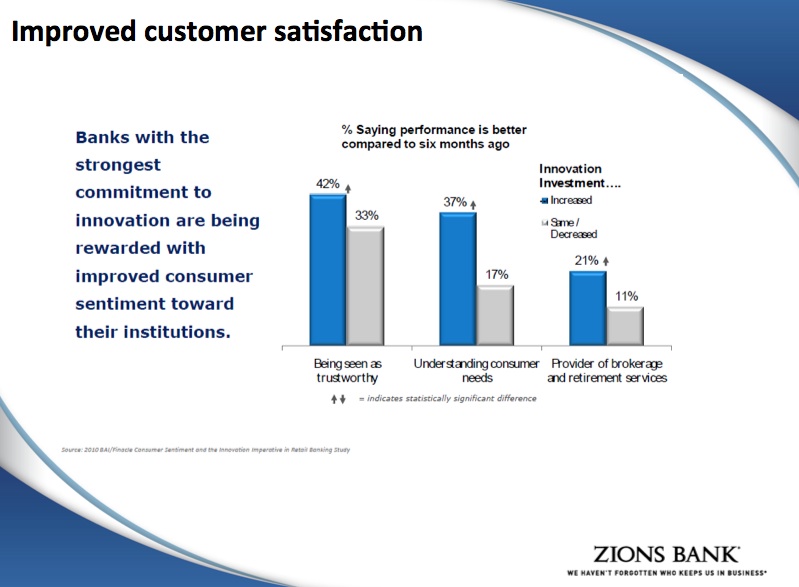 So my recommendation isn’t so much to innovate where you think customers may someday be as to innovate where customers are already headed. In my own field of interactive bank marketing, we know that in the last quarter of 2013, 54 million people in the U.S. used a mobile device to access their bank information, 32 million to access their credit card information, and 30 million to view or make electronic payments. So banks that want to be around right now, much less in the future, must lead in the mobile arena. No wonder we see that banks with the strongest commitment to innovation tend to win greater customer loyalty and commitment.
The key to successful innovation is to foster a vibrant environment that involves people organization-wide in discovery and dialog, and can distill that dialog into value-generating ideas. Your work is cut out for you.
Matt Wilcox addresses the Chief Strategy Officer Summit on Friday May 24
Marketing Lesson From
Birds Wearing Funny Hats
(About my upcoming presentation at the Chief Strategy Officer Summit)
Early in the 1980s, biologist Nancy Burley fastened tiny hats atop the heads of zebra finches. It soon became clear that the female finches really dug the males with red hats. Males with other-colored hats or no hat at all could hardly compete. Worst off were the males in green hats, from whom the females pretty much fled.
Ornithological implications aside—what moved Burley to try this in the first place is its own story—there is a marketing lesson here. The slickest, most creative sales pitch cannot sell green to a market with its heart set on red. Moreover, there is no telling when a capricious market might change its mind and want blue.
But although the finches were doomed to make do with the color Burley bestowed upon them … you, by contrast, can change your hat.
If the market wants red, you can shed green and deliver red. Even better, you can deliver red in a way no one has ever delivered red before and take the market by storm. If the market changes its mind and wants blue, you can deliver blue.
Trouble is, most of us won’t.
Which raises the question, why the heck not?
Permit me to suggest some possible reasons:
It’s not easy predicting the future. In 1962, Decca Records executive Dick Rowe dismissed an unknown band calling itself The Beatles. “Guitar groups are on the way out,” he said. Lest we be smug, who could have known just a few years ago that texting would overtake speaking as the primary use of a phone?
Stubbornness. No one is immune. Starbucks CEO Howard Schultz bought out his stubborn partners so the company could segue from roasting alone to brewing and selling drinks by the cup. Yet Schultz himself stubbornly refused to accede to loud-and-clear customer demand for lattes made with nonfat milk. He capitulated only after Starbucks lost untold business to more flexible competitors.
Failure to hear. When you’re convinced you’re right, it’s easy to make data appear to mean what you want it to mean. Politicians make an art of it. Throw a rock and you’ll hit 20—on either side of the aisle—who use the same data to support opposing points of view.
Institutionalized lack of nimbleness. This may come in the form of leadership that is slow to take action. It may also come in the form of encumbrances not easily shed. Consider a vertical such as a bookstore or video rental chain that moves to an online model, leaving an established company saddled with suddenly obsolete real estate and inventory.
Limited resources. Change is costly, and some companies lack the funds. But some refuse to invest them, perhaps overlooking the fact that going out of business can cost a good deal more than innovating.
Let’s be fair. These and other traits can be listed under “Being Human.” But the knowledge that you are human is small consolation when your company falls behind or goes out of business.
But—good news—you’re not a zebra finch. You can change your hat for the right color. All it takes is staying a beat ahead of the hat-demand curve.
How? Funny you should ask. That’s what I’m speaking about on May 24 at the Chief Strategy Officer Summit in San Francisco. You should attend! If you can’t make it, all is not lost. I’ll share highlights from my presentation in an upcoming post.
I LOVE VISITING the Apple Store. Corner any employee and ask a question. Odds are you won’t get just an answer. You’ll get a gushing, aren’t-our-products-are-amazing? answer. Out of the millions of people who are sold on Apple products, no one appears quite as sold as Apple employees themselves. Their excitement is downright contagious. They make it nigh unto impossible for me to keep my wallet holstered.
It’s a great reminder to the rest of us marketers. Too often, we take care to romance and sell our mobile applications to outsiders, while with employees we default merely to “explaining” or, worse, “training.” After all, reason not a few managers, these people work for us. It’s their job to be enthused, right?
Wrong. Employees are customers. As with any customer, it takes more than a cursory introduction to get employees to march under your banner with gusto. You cannot afford to assume that they are innately psyched about your mobile strategies and other offerings.
This matters, because employees are hugely influential. At work, they interact with customers. Many are responsible for selling in person, on the phone or online. Those who aren’t directly responsible for sales still encounter customers and make an impression. Away from work, employees interact with family and friends who are customers or potential customers. Their insider status gives them greater credibility than your paid advertising. If they are versed and enthusiastic, their enthusiasm will shine convincingly through. If they aren’t, their lack of it will be an open, yawning, warning abyss.
So here’s a thought. Keep your employees plugged in. Let them know what you have cooking, who you’re cooking it for, and when you predict it will be ready. Let them know what makes it so cool. Give them sneak peaks. Don’t just send them a memo with operational procedures. Don’t just explain or train. Get them jazzed. Sell to them.